
Introduction
Business buyers don't wait for a sales call anymore. They research solutions independently, compare vendors online, and loop in colleagues long before a rep ever hears from them.
That shift is the core challenge behind B2B lead generation today. Many business owners drive plenty of website traffic or form fills, yet struggle to convert those inquiries into leads their sales teams can actually close.
This guide breaks down what B2B lead generation really means and which strategies are producing results heading into 2026. You'll get a step-by-step process from persona to conversion, plus how to measure whether your program is working.
Key Takeaways
- B2B lead generation attracts businesses likely to buy your product or service, not individual consumers
- Marketing Qualified Leads (MQLs) and Sales Qualified Leads (SQLs) need different follow-up paths
- Buying committees, longer sales cycles, and content strategy set B2B apart from B2C
- Inbound plus outbound tactics, mapped to buyer stage, build the strongest pipeline
- Quality beats volume: track metrics that surface prospects ready to buy
What Is B2B Lead Generation?
B2B lead generation is the process of identifying, attracting, and capturing contact information from other businesses that are potential buyers of your product or service. It's the engine that fills a sales pipeline with real prospects instead of cold names on a spreadsheet.
Here's the distinction that trips people up: a real B2B lead isn't a generic "info@company.com" address. It's a named individual (a decision-maker or influencer within a target company) who has shown some level of interest or fit.
That individual rarely acts alone. According to Forrester's 2026 State of Business Buying report, a typical B2B purchase decision now involves 13 internal stakeholders and nine external influencers, and that number climbs for complex or strategic purchases.
Generating one interested contact isn't enough anymore. You're building interest across an entire buying committee.
Marketing Qualified Leads (MQLs) vs. Sales Qualified Leads (SQLs)
Not every lead deserves the same follow-up. Splitting leads into two buckets keeps sales and marketing focused on the right prospects at the right time:
- MQL (Marketing Qualified Lead): Engaged with marketing content (guide download, newsletter, webinar) but isn't ready to buy. Needs nurturing, not a sales call.
- SQL (Sales Qualified Lead): Showed direct buying intent (demo request, sales contact, pricing question). Fast-track to a rep immediately.
Treating an MQL like an SQL burns goodwill with a pushy pitch. Treating an SQL like an MQL means a hot prospect goes cold while you send them another blog post.
B2B vs. B2C Lead Generation: What's the Difference?
B2B and B2C lead generation look nothing alike once you dig past the surface. According to TechTarget, B2B sales cycles run longer because purchases involve multiple participants and happen less often. They also tend to be larger investments that affect more people across the organization.
| Factor | B2B | B2C |
|---|---|---|
| Decision-makers | Multiple stakeholders | Usually one person |
| Sales cycle | Weeks to months | Minutes to days |
| Deal value | Higher, recurring | Lower, one-time |
| Content style | Case studies, ROI data | Emotional appeal, urgency |
| Primary channels | LinkedIn, email, referrals | Instagram, Facebook, paid social |
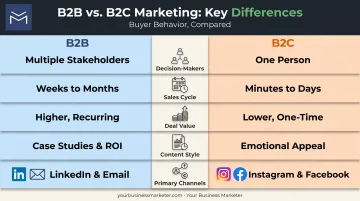
B2C marketing leans on impulse and emotional triggers. B2B marketing has to justify a purchase to a committee, which is why case studies, whitepapers, and ROI-driven content carry so much more weight.
Why B2B Lead Generation Matters
Without a steady lead generation engine, the sales pipeline dries up fast and revenue follows. Lead gen is the fuel supply for growth, not a side project for marketing.
A strong lead gen strategy does more than fill a pipeline. It also:
- Uncovers your total addressable market by revealing which industries, company sizes, and regions actually respond
- Sharpens buyer personas from real engagement data, not assumptions
- Guides content and campaign choices so you know what messaging works before you scale spend
Lead engagement data makes that sharper over time. When you know which content leads viewed and which channels converted, you refine targeting with evidence instead of guesswork.
Content marketing backs this up at scale. In the Content Marketing Institute's B2B benchmark research, 74% of marketers said content marketing helped generate demand and leads, while 49% said it directly helped generate sales and revenue. Nearly half of those teams can trace closed revenue to content-driven leads.
Top B2B Lead Generation Strategies for 2026
No single tactic carries a B2B program alone. The strongest results come from combining inbound and outbound channels while prioritizing lead quality over raw volume.
Content Marketing & SEO
Thought leadership content (blogs, whitepapers, in-depth guides) builds trust with buyers long before they ever contact sales. Buyers are doing serious homework before that first conversation.
Gartner's 2026 survey found B2B buyers now consult an average of seven information sources during a purchase. If your content isn't one of them, a competitor's probably is.
SEO is what makes that content findable in the first place. Ranking for the terms your buyers actually search puts you in front of prospects at the exact moment they're evaluating solutions.
Paid Advertising & Social Selling
LinkedIn Ads and targeted PPC campaigns reach decision-makers directly through professional and firmographic targeting (job title, company size, industry) instead of broad demographic guessing.
Social selling complements paid reach: reps use LinkedIn and similar networks to share useful insights, build familiarity, and warm accounts before a sales conversation.
Multi-channel paid campaigns tend to outperform single-channel efforts. YBM's own client work illustrates this:
- Wisconsin Buy Here Pay Here group: site traffic up 40% in 30 days, visitors doubled in six months, leads up 36% YoY
- New Ohio used-car dealership: 400+ leads by month three; leads and sales up 30% within one year
- Rural Chevrolet dealership: 626 online leads and 1.34 million programmatic impressions over two years
- Autism therapy center: new website contacts at $2.07 social CPC and $3.19 programmatic CPC
Agencies like YBM manage this mix (PPC, geofencing, and programmatic) for home services, dealership, and specialty health clients to keep qualified leads flowing consistently.
Email Marketing & Account-Based Marketing (ABM)
Segmented, automated email sequences move leads through the funnel without manual follow-up on every contact.
ABM is the focused counterpart: personalized outreach to specific high-value accounts, with the right message at each stage. Together, automation and ABM prioritize fit and timing over one generic blast to everyone.
Referrals, Reviews & Case Studies
B2B buyers trust other buyers more than they trust your sales deck. Demand Gen Report's 2024 B2B Buyer's Survey found 31% of buyers listed peer reviews among the first three resources they checked during their buying journey.
Case studies work the same way, showing real results rather than promises. One HVAC contractor that combined SEO, PPC, email, and reputation management grew revenue 85% over two years, proof that helps turn a skeptical prospect into a confident buyer.
The B2B Lead Generation Process: From Persona to Conversion
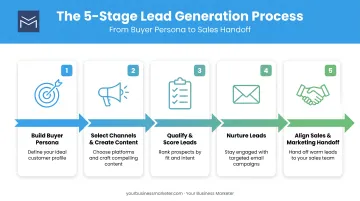
Building a repeatable pipeline means following a process, not chasing random tactics. Here's the sequence that works:
- Build a detailed buyer persona — company size, industry, job title, pain points, and purchase criteria — so outreach targets the right prospects instead of everyone.
- Select channels and create content mapped to funnel stage — blog posts serve early-stage awareness; demos and case studies close decision-stage leads.
- Qualify and score leads based on engagement and fit, separating MQLs from SQLs so sales only chases high-intent prospects.
- Nurture leads with timely, personalized follow-up across email, retargeting ads, and direct outreach until they're actually ready to buy.
- Align the sales and marketing handoff so SQLs get contacted quickly and consistently — a delayed follow-up is often the difference between a closed deal and a cold lead.
That last step trips up more companies than any other. One YBM automotive client's paid campaign generated so much lead volume in its first month that the sales team had to pause the campaign just to catch up — proof that handoff speed matters as much as lead volume.
Measuring Success & Choosing the Right Partner
Tracking the right numbers tells you whether your lead gen program is actually working, or just generating activity. Core metrics to watch:
- Cost per lead (CPL): what you're paying to acquire each contact, by channel
- Lead-to-close conversion rate: how many leads actually become customers
- Pipeline contribution by channel: which sources drive real revenue, not just form fills
Two problems show up repeatedly: low-quality leads clogging the pipeline, and sales/marketing misalignment on what counts as "qualified." Watching CPL alongside conversion rate — not CPL alone — catches both issues early, before budget gets wasted chasing volume.
An insurance agency client tracked through YBM's campaigns generated 48 leads in 90 days at a $13.82 average social CPL, plus 1.25 million programmatic impressions. That channel-level visibility shows exactly where budget is working.
Getting that clarity across SEO, paid, email, and reputation work is hard when your team is already stretched. Most growing businesses don't have the bandwidth to run all four at once, let alone report on them. That's where a full-service partner earns its keep.
YBM handles SEO, PPC, programmatic, email, and reputation management under one roof. That's how an HVAC client hit an 85% revenue increase over two years without juggling multiple vendors.
Frequently Asked Questions
What does "B2B lead" mean?
A B2B lead is a named individual within a business who has shown interest in your product or service, not a generic company inquiry. It always ties back to a real decision-maker or influencer, not just a company email address.
What is the difference between B2B and B2C lead generation?
B2B involves larger buying committees, longer sales cycles, and ROI-driven content on channels like LinkedIn. B2C targets individual buyers with shorter cycles and emotional messaging on platforms like Instagram and Facebook.
What are the most effective B2B lead generation strategies for 2026?
A mix of content marketing and SEO, LinkedIn and paid social, account-based marketing, and referral-driven campaigns performs best. No single channel carries a program alone anymore.
What's the difference between an MQL and an SQL?
An MQL has engaged with content but isn't ready to buy, such as webinar attendees or guide downloads. An SQL has shown direct buying intent, like requesting a demo, and should go straight to sales.
How much does B2B lead generation typically cost?
Costs vary widely by channel and industry, so cost-per-lead should never be judged in isolation. Always weigh CPL against lead quality and conversion rate, not just how cheaply you can generate volume.
How long does it take to see results from B2B lead generation?
Outbound tactics like paid ads and email typically show results faster, often within weeks. Inbound efforts like SEO take longer to build momentum but generally deliver more sustainable, lower-cost leads over time.