
Introduction
It's 7 a.m. and the HVAC company owner is already three tabs deep: checking Google Ads spend, replying to a Facebook review, and wondering why last month's email blast barely got opened. By 9 a.m., the trucks are rolling and marketing gets shelved until tonight, if it gets touched at all.
That scramble is common. Marketing leaders now outsource 20.2% of their marketing activities, and they expect that share to grow another 5% within the year, according to The CMO Survey's Fall 2023 report. Businesses are realizing they can't master every channel alone.
This article breaks down what a digital marketing consultant actually is, what they do day to day, what they typically charge, and how to know when it's time to bring one in.
Key Takeaways
- Digital marketing consultants advise from the outside—they guide strategy, not replace your full team.
- Typical scope spans strategy, SEO/PPC/social/email guidance, performance tracking, and staff training.
- Pricing usually follows hourly, project-based, or monthly retainer models; retainers are most common.
- Full-service agencies pair consulting-level strategy with hands-on execution for stronger ROI.
- Best fit hinges on industry experience, transparent reporting, and proof of measurable results.
What Is a Digital Marketing Consultant?
A digital marketing consultant is an external professional brought in to evaluate a company's digital presence, build a strategy around it, and guide how that strategy gets executed. They're not simply "doing the marketing" from inside your office.
Indeed's definition describes them as experts who advise companies on improving their digital marketing efforts and, in many cases, help build out the actual campaigns.
The key distinction is strategic versus tactical. A consultant focuses first on the why and what, meaning:
- Why is traffic flat despite a healthy ad budget?
- What channels deserve the next dollar spent?
- What does success look like in 90 days versus 12 months?
Many consultants also step into the how, helping set up campaigns or coaching a team through execution. That overlap is exactly why titles like "online marketing consultant," "internet marketing consultant," and "fractional CMO" get used almost interchangeably.
A fractional CMO typically sits at the higher end, taking on executive-level strategy responsibilities without the full-time commitment of an in-house hire.
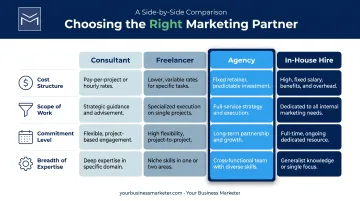
How a Consultant Differs from an Agency, Freelancer, or In-House Hire
Set beside an in-house marketing manager, the difference is employment structure. The manager is a salaried employee focused on one company. A consultant works across industries, engaged by project or retainer, and brings outside perspective the in-house hire simply can't have.
The gap with a freelancer is scope. Freelancers usually handle one channel, say, writing blog posts or managing a single ad account. Consultants take a broader, whole-funnel view of how SEO, paid media, email, and social should work together.
Against a full-service agency, the line gets blurrier. Many agencies fold consulting directly into execution. Your Business Marketer (YBM), for example, doesn't just advise on SEO or PPC. It handles strategy, campaign management, reputation monitoring, and reporting under one engagement, closer to a consultative partner than a strategy-only advisor.
| Factor | Consultant | Freelancer | Agency | In-House Hire |
|---|---|---|---|---|
| Cost structure | Hourly, project, or retainer | Hourly or per-task | Retainer (often bundled) | Salary + benefits |
| Scope of work | Strategy across channels | One channel or task | Strategy + execution across channels | Whatever the role covers |
| Commitment level | Flexible, often short-term | Task-by-task | Ongoing retainer | Permanent |
| Breadth of expertise | Cross-industry strategic view | Deep in one skill | Team of specialists | Limited to one person's skills |
What Does a Digital Marketing Consultant Do?
Most engagements start with an audit. The consultant reviews existing campaigns, traffic patterns, and conversion data to spot what's working and what's draining budget. From there, they build a data-backed strategy and set measurable KPIs such as cost per lead, organic traffic growth, or email open rates.
Channel-specific work typically includes:
- SEO recommendations — keyword targeting, technical fixes, content gaps
- Paid ad structuring — campaign builds across Google Ads and social platforms
- Email strategy — segmentation, automation flows, retention messaging
- Content and social guidance — messaging direction and channel-fit recommendations
Reporting is where accountability lives. A consultant tracks traffic, conversion rate, and ROI, then recommends ongoing tweaks rather than a one-time fix. Coursera's overview of marketing consulting notes that many consultants also train a company's internal marketing staff to carry out the strategy, rather than executing every piece themselves.
That's a meaningful fork in the road. Some consultants hand off a playbook and coach your team through it. Others, like full-service agencies, keep execution in-house. YBM's model leans toward the latter: strategy, account management, and hands-on execution all happen under one roof as a "set it and forget it" arrangement for the business owner.
Specialization also matters. A consultant working with senior living communities markets very differently than one working with auto dealerships or home improvement contractors. Tactics, ad platforms, and even the language used in campaigns shift by vertical.
Common Types of Digital Marketing Consultants
- SEO consultants — focus purely on organic search visibility
- PPC/paid media consultants — manage ad spend across Google and social platforms
- Social media consultants — build paid and organic social strategy
- Content marketing consultants — oversee blog, video, and asset creation
- Full-service or fractional CMO consultants — oversee every channel under one strategy
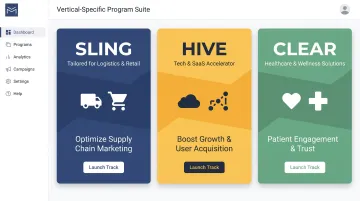
Agencies with deep vertical experience often build this specialization into repeatable programs. YBM, for instance, runs SLING for senior living, HIVE for home services, and CLEAR for car dealerships. Parallel programs cover nonprofits (FIT), city growth (CORE), and job recruitment (REC), each tailored to how that industry's buyers behave online.
How Much Does a Digital Marketing Consultant Charge?
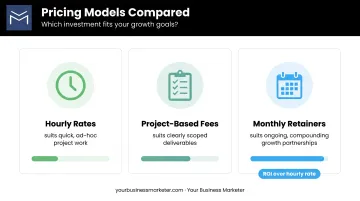
Three pricing models dominate the market:
- Hourly rates — common for short, defined projects or one-off audits
- Project-based fees — a flat cost for a specific deliverable, like a full site audit or campaign build
- Monthly retainers — the most common structure for ongoing strategic work
Rates vary widely, and Twine's research on consultant pricing notes that fees climb as the work becomes more strategic, specialized, and accountable for results. A junior consultant handling basic reporting costs far less than a seasoned strategist managing multi-channel campaigns for a competitive industry.
What drives the price up or down:
- Experience level and track record
- Number of channels covered (SEO alone versus SEO + PPC + social + email)
- Business size and industry complexity
- Whether hands-on execution is included, or just advice
Here's where solo consultants and full-service agencies split. A standalone consultant charging hourly or retainer fees typically hands you a strategy document and leaves execution to your team or another vendor.
A full-service agency bundles strategy with actual campaign management. That often delivers more value per dollar, since you're not paying separately for a strategist and then an execution team.
YBM's structure illustrates this. Instead of hourly consulting fees, its packages bundle programmatic advertising, paid social, website updates, and creative assets like 3-4 videos per year into one annual engagement. That's a different value equation than paying a consultant hourly for advice alone.
The smarter comparison weighs cost against expected ROI, not hourly rate against hourly rate. A $3,000-a-month retainer that generates measurable revenue growth beats a $50-an-hour consultant whose recommendations never get implemented.
Benefits of Hiring a Digital Marketing Consultant
Hiring a digital marketing consultant gives you specialized, current expertise—SEO algorithm updates, new ad platform features, evolving social trends—without hiring and training a full internal team.
An outside perspective spots what internal teams miss. Someone inside the business gets used to how things have always been done. A consultant walks in cold and asks why the checkout page has a three-step form or why the ad budget hasn't shifted in two years.
That objectivity shows up in results. When YBM took over marketing for a Wisconsin dealership group, site traffic rose 40% within 30 days and doubled within six months, while leads climbed 36% year-over-year. A separate used-car dealership generated over 400 leads by month three after a similar overhaul.
Cost efficiency is the other draw. Businesses pay for the expertise level and time they actually need:
- No long-term salary or benefits overhead
- Scale up during peak seasons, scale down when things are quiet
- Skip the cost of building an internal team from scratch
An HVAC contractor working with YBM saw 85% revenue growth over two years after adding SEO, PPC, email, reputation management, and social media into one coordinated strategy. That multi-channel track record is hard to replicate with a single in-house generalist.
Signs Your Business Needs a Digital Marketing Consultant (and How to Choose One)
Certain patterns signal it's time to bring in outside help:
- Traffic or lead volume has plateaued for months
- Branding looks inconsistent across your website, ads, and social profiles
- Marketing ROI is unclear or unmeasured
- Internal team is too thin to cover every channel
Once you've spotted the signs, vetting a consultant or agency partner comes down to a few non-negotiables:
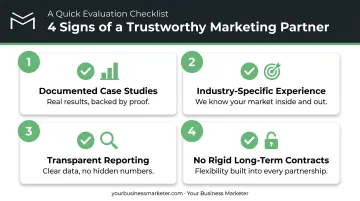
- Documented case studies with real, measurable numbers, not vague claims
- Industry-specific experience in your vertical, not general marketing know-how
- Transparent reporting tied to dollars and cents, not vanity metrics
- No rigid long-term contracts that lock you in without proven value
YBM's HVAC case study is a useful benchmark here: 85% revenue growth over two years, paired with website traffic climbing from 200 to nearly 1,000 monthly visitors in the first month alone.
That's the kind of documented, trackable outcome worth demanding from any partner, whether a solo consultant or a full-service agency handling SEO, PPC, social, and reputation management.
Frequently Asked Questions
What does a digital marketing consultant do?
A digital marketing consultant audits your current marketing, builds a data-backed strategy, and guides execution across SEO, PPC, social, and email. Many also track performance metrics and recommend ongoing optimizations.
How much does a digital marketing consultant charge?
Pricing follows three models: hourly rates for short projects, flat project fees for specific deliverables, or monthly retainers for ongoing strategic work. Retainers are most common and scale with experience level and channel scope.
Is it worth hiring a digital marketing consultant for a small business?
For small businesses without in-house digital expertise, yes. The ROI case comes from avoiding wasted ad spend and missed opportunities that an experienced outside eye typically catches fast.
What's the difference between a digital marketing consultant and a marketing agency?
A consultant often provides advisory-only guidance, leaving execution to your team. A full-service agency bundles that same strategic advice with hands-on campaign management across channels.
How long does it take to see results from a digital marketing consultant?
PPC campaigns typically move through a platform learning period of 48 hours to 2-4 weeks. SEO takes longer, with Shopify's guide noting most sites see measurable results in 3-6 months, longer in competitive industries.
Can a digital marketing consultant replace an in-house marketing team?
It depends on business size and needs. Some companies use a consultant to supplement a lean internal team, while others rely on one entirely in place of hiring in-house staff.