That's the internet marketing problem in a nutshell. Your customers are already searching, scrolling, and clicking. The question is whether they find you or the business down the street.
Internet marketing (also called online marketing, and used interchangeably with "digital marketing" in most everyday business conversations) is the umbrella term for every promotional effort that happens through internet-based channels. This article breaks down what it actually means, the core channels worth your attention, real examples of it working, and how to build a strategy without wasting your budget.
Key Takeaways
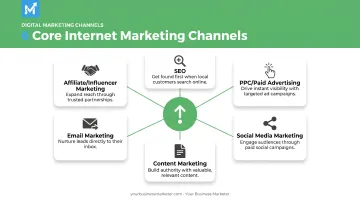
- Internet marketing spans SEO, PPC, social media, email, content, and affiliate channels.
- You can target specific audiences and track results in real time—unlike most traditional ads.
- Most small businesses get stronger results from five core channels than from chasing every new tactic.
- Pick 2–3 channels that fit your audience instead of spreading budget thin across everything.
What Is Internet Marketing?
Internet marketing means using internet-based channels and technologies—websites, search engines, social platforms, email, and online ads—to promote products or services and connect with potential customers.
The American Marketing Association frames it as the online subset of digital marketing. Common examples include SEO, PPC, social media, email, affiliate, and content marketing.
How Internet Marketing Works
The core idea is simple: put your message where your audience already spends time, instead of broadcasting to everyone and hoping the right people notice.
That means:
- Showing up in search results when someone searches "HVAC repair near me"
- Appearing in social feeds while someone scrolls Instagram
- Landing in an inbox with a relevant offer at the right moment
What makes this different from a billboard or radio spot is tracking. Cookies, analytics, and pixels let marketers measure clicks, impressions, and conversions with precision that traditional media simply can't match. You know which ad brought in which customer—not a vague sense that "advertising is working."
Internet Marketing vs. Digital Marketing: What's the Difference?
Technically, internet marketing is a subset of digital marketing. Digital marketing also includes offline digital channels like SMS text campaigns and app push notifications that don't require an internet connection to reach the user.
In practice, almost nobody splits hairs over this. Business owners use "internet marketing," "online marketing," and "digital marketing" interchangeably, and that's fine. Focus on strategy, not terminology.
Key Benefits of Internet Marketing for Small Businesses
Why does this matter for a small business owner weighing where to spend limited dollars?
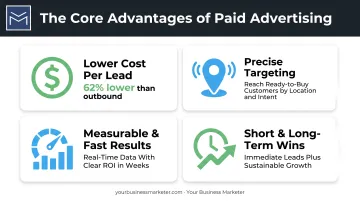
- Lower cost per lead: Inbound-dominated organizations report a 62% lower cost per lead than outbound-dominated ones (HubSpot)—SEO and content typically beat print or broadcast on CPL over time
- Precise targeting: Reach by location, demographics, interests, and search intent so local businesses (HVAC, home services, clinics) don't burn budget on the wrong zip codes
- Measurable and fast: See results in days, not months, and shift spend toward what works instead of guessing like you would with print, radio, or billboards
- Short-term and long-term wins: PPC and social ads drive quick leads while SEO and reputation build compounding visibility underneath
Types and Channels of Internet Marketing
There are dozens of niche tactics out there, but most internet marketing efforts fall into a handful of core channels. Each suits different goals, timelines, and budgets.
Search Engine Optimization (SEO)
SEO means optimizing your website's content and structure to rank higher in organic search results. It's a long-term play, but it tends to deliver strong ROI once it gains traction.
SEO rests on three pillars:
- Technical SEO – site speed, crawlability, sitemaps, HTTPS, and internal linking
- On-page content – the actual words, headers, and structure on your pages
- Off-page/link building – backlinks and mentions that signal trust to search engines
For small businesses with a physical location, local SEO matters most. Google says local ranking depends heavily on relevance, distance, and prominence. Complete business information, consistent citations, and positive reviews directly affect whether you show up in local searches.
Pay-Per-Click (PPC) and Paid Advertising
PPC means you pay only when someone clicks your ad, typically through Google Ads or Meta Ads. It's the fastest way to get in front of people actively searching for what you sell.
Costs vary a lot by industry. WordStream's 2025 benchmarks put the median cost-per-click at $5.26 across all industries, but that range varies widely by vertical:
| Industry | Median CPC |
|---|---|
| Automotive repair/parts | $3.90 |
| Physicians/surgeons | $5.00 |
| Dental | $7.85 |
| Home improvement | $7.85 |
| Legal/attorneys | $8.58 |
Geotargeting is where PPC gets smart for local businesses. Google Ads lets you target by city, radius, or location group, and exclude areas entirely, so you're not paying for clicks from people who'll never become customers.
Social Media Marketing
Businesses use platforms like Facebook, Instagram, and LinkedIn to build brand awareness, engage existing customers, and run targeted paid campaigns. Posting alone isn't enough. Consistent presence on the platforms where customers already spend time is what builds trust.
The influence is real: 39% of U.S. social media users say influencers or content creators affect their purchase decisions at least a little, according to Pew Research. Influencer impact is now mainstream shopping behavior.
Content Marketing
Content marketing means creating blog posts, videos, or guides that answer customer questions and build trust over time. You earn attention gradually instead of pushing for an immediate sale.
According to the Content Marketing Institute's 2025 B2B benchmarks, 74% of marketers said content helped generate demand or leads, and 71% distributed that content through email newsletters. Content rarely works alone, though. It compounds best when paired with SEO (so people find it) and email (so it keeps nurturing leads after that first visit).
Email Marketing
Email remains one of the most cost-effective channels for nurturing leads and retaining existing customers through newsletters, promotions, and automated sequences.
Key metrics to track:
- Open rate – industry averages sit around 32-36%, per Constant Contact and Mailchimp benchmarks
- Click-through rate – typically 2-2.6% across industries
- Segmentation impact – marketers report 30% more opens and 50% more clicks from segmented lists versus generic blasts
Best practice: Segment your list. Sending the same message to a first-time buyer and a 10-year customer wastes the opportunity to speak to each one directly.
Affiliate and Influencer Marketing
This channel works through partnerships: businesses pay influencers or affiliate publishers a commission or fee to promote products. Since payment is typically tied to actual sales or leads, it's relatively low-risk and pay-for-performance by design.
Growth here has been fast. The IAB projects $37 billion in U.S. creator advertising spend for 2025, up 26% year-over-year, growing nearly four times faster than the overall media industry. Instagram and TikTok have been the primary engines behind that expansion.
Real-World Examples of Internet Marketing in Action
Theory is one thing. Here's what coordinated internet marketing actually looks like when it's working.
SEO and PPC for a Home Services Business
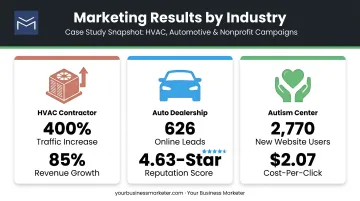
A Northeast Ohio HVAC contractor, in business since 1990, saw website traffic grow from 200 to nearly 1,000 monthly visitors in just one month, a 400% increase. The approach combined local SEO (ranking for terms like "AC installation" and "heating and cooling repair"), Google Ads for immediate visibility, and reputation management to build trust.
That multi-channel model is the same approach behind YBM's HIVE program for home services and home improvement contractors, which bundles SEO, PPC, email, reputation management, and social media. A related HVAC client documented 85% revenue growth over two years, with results tracked to phone calls and qualified leads—not just traffic numbers.
Social Media and Reputation Management for a Dealership
A rural Chevrolet dealership combined paid and organic social media, programmatic advertising, and SEO over two years. Results included:
- 626 online leads
- 305 dealership visits
- 585,359 paid-social impressions
- Local reputation score of 4.63 out of 5 stars
A separate newly opened used-car dealership took a similar path, pairing online advertising with SEO and reputation management. It generated more than 400 leads by month three and saw 30% growth in leads and sales within a year, with cost per sale at half the national average.
Multi-Channel and Email Nurture Campaigns
For a Northeast Ohio autism center, programmatic ads, paid and organic social, and SEO drove:
- 2,770 new website users
- 31 new website contacts in the first 120 days
- Social media cost per click of $2.07
Email is simpler on the surface but still drives revenue. One HVAC business sent monthly newsletters to 1,800 previous customers and generated new business shortly after launch.
How to Build an Internet Marketing Strategy
Building a strategy doesn't require doing everything at once. It requires doing the right things in order.
- Define your audience and goals. Choose 2–3 channels that match where that audience actually spends time, not every channel available.
- Get your website ready. Every channel eventually drives traffic back here. If it's slow or not mobile-friendly, you're leaking leads before they even reach you.
- Set up tracking before you launch. Conversion tracking—whether through Google Analytics, call tracking, or website lead tracking—shows what's working so budget goes where it counts.
- Consider a coordinated approach. Business owners short on time or expertise often partner with a full-service agency such as Your Business Marketer to run SEO, PPC, paid social, and email as one strategy instead of disconnected efforts.
The businesses seeing the strongest results rarely run one channel in isolation. They coordinate SEO, paid ads, and reputation management so each channel reinforces the others.
Challenges to Keep in Mind
Internet marketing isn't "set it and forget it." A few realities worth planning for:
- Algorithms change constantly. What ranked last year on Google or performed well on Instagram may need adjustment today.
- Data overload is real. More metrics don't mean better decisions. You need to know which numbers actually tie to revenue.
- Costs are climbing. Google Search CPC rose 12.88% year-over-year, and average cost-per-lead increased from $66.69 to $70.11.
- Standing out is harder. 43% of B2B marketers cite differentiating their content as an ongoing challenge.
Consistent, quality execution across channels matters more now than it did five years ago, because more businesses compete for the same attention.
Frequently Asked Questions
What is internet marketing?
Internet marketing is promoting a business through internet-based channels like websites, search engines, social media, and email. It covers everything from SEO to paid ads to newsletters.
What are five types of online marketing?
The five most common types are SEO, PPC/paid advertising, social media marketing, email marketing, and content marketing. Most small businesses combine several of these rather than relying on one.
Is internet marketing the same as digital marketing?
Technically, internet marketing is a subset of digital marketing, since digital marketing also includes offline channels like SMS. In everyday use, though, the terms are interchangeable.
How much should a small business budget for internet marketing?
Budgets vary widely by industry and goals, with PPC costs alone ranging from roughly $4 to $9 per click depending on your field. Start small with trackable channels like PPC or local SEO, then scale based on what converts.
Do I need to hire an agency for internet marketing?
Some businesses manage it in-house, but many owners partner with a full-service agency to save time and get coordinated, measurable results across channels. It depends on your available time and in-house expertise.
Which internet marketing channel should a beginner start with?
Start with a solid, mobile-friendly website, then add one paid channel (PPC) and one organic channel (SEO or social). That combination balances fast results with long-term, sustainable visibility.