Despite that, most business owners still hear terms like "DSP" and "real-time bidding" and tune out. Many struggle to separate the buzzwords from the mechanics, which leads to hesitation, wasted budget, or picking the wrong platform entirely.
This guide breaks down what programmatic advertising actually is and exactly how it works, step by step. No jargon left unexplained.
Key Takeaways
- Programmatic advertising automates digital ad buying through software, replacing manual negotiations with real-time auctions
- DSPs, SSPs, ad exchanges, and DMPs match advertisers with available ad space in under a second
- Buyers can choose from four deal types: open marketplace, private marketplace, preferred deals, and programmatic guaranteed
- Campaigns span display, video, CTV, audio, and native formats
- Small businesses can access programmatic channels as easily as major brands
What Is Programmatic Advertising?
Programmatic advertising is the automated buying and selling of digital ad inventory across channels (display, video, connected TV, audio, mobile, and native) using software and algorithms instead of manual insertion orders. A human doesn't call a publisher and negotiate a rate. A machine does it, thousands of times per second.
Here's the gap it closes. Traditional ad buying meant:
- Slow back-and-forth negotiations between agencies and publisher sales teams
- Fixed pricing regardless of audience quality or demand
- Guesswork on where ads would actually appear
Programmatic replaces all of that with speed, audience data, and pricing that adjusts in real time based on who's actually looking at the page.
One clarification matters here: programmatic is a buying method, not a format. A video ad bought programmatically is still a video ad. A display banner bought programmatically is still a display banner. What changes is how that placement got purchased: through an automated auction rather than a direct deal with a publisher's sales rep.
Programmatic has also had to adapt. As third-party cookies face increasing restrictions across browsers, the industry has shifted toward contextual targeting and first-party data matching. The IAB Tech Lab's PAIR specification, for instance, standardized how advertisers can securely match their own first-party data with publishers' without relying on a shared cookie.
Despite that disruption, US programmatic ad spending was still forecast to surpass $200 billion in 2026. The channel isn't slowing down.
Key Players in the Programmatic Ecosystem
Four pieces of software make this entire system function. Here's what each one does:
| Player | Role |
|---|---|
| DSP (Demand-Side Platform) | Software advertisers and agencies use to set targeting, budget, and bidding rules, then buy inventory across many publishers at once |
| SSP (Supply-Side Platform) | Software publishers use to list their available ad space and auction it to multiple buyers simultaneously |
| Ad Exchange | The digital marketplace where SSPs and DSPs actually meet and the auction happens |
| DMP (Data Management Platform) | The data layer that aggregates first- and third-party audience data to inform targeting decisions |
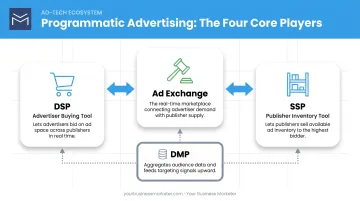
Think of the DSP as the buyer's shopping cart and the SSP as the publisher's inventory shelf. The ad exchange is the checkout counter where the transaction clears, all before the page finishes loading.
How Does Programmatic Advertising Work?
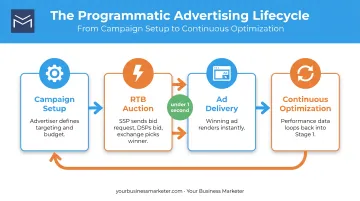
The entire process, from an ad space becoming available to an ad rendering on screen, happens in under a second, according to Google's own documentation on real-time bidding. It's triggered every single time a user loads a webpage or app with open ad inventory.
Campaign Setup & Initiation
Before anything goes live, the advertiser defines campaign parameters inside a DSP:
- Target audience (demographics, interests, behaviors)
- Budget and bid limits
- Geography
- Campaign objective (awareness, clicks, conversions)
Once that's set, the campaign runs continuously and automatically. Every time a real user with open ad space loads a page, the SSP flags that impression as available. That single page load is what kicks off the entire auction process — no manual trigger needed.
Core Operation: The Real-Time Bidding Auction
The real-time bidding auction runs in milliseconds. Here's the sequence:
- The SSP sends a bid request through the ad exchange to connected DSPs, with anonymized user data plus ad space details (size, page content, device type)
- Each DSP's algorithm evaluates the match (does this impression fit the advertiser's target audience?) and places a bid based on budget and campaign goals
- The ad exchange collects competing bids and selects a winner, usually the highest valid bid
All of this resolves before the webpage even finishes rendering. No person is clicking "approve" in the middle of this. It's algorithm against algorithm, dozens of times over, for every single ad slot on every page a user visits.
Output: Ad Delivery & Continuous Optimization
The winning ad renders instantly on the publisher's site or app. The user sees it almost immediately after the page starts loading.
But the process doesn't stop there. Performance data (impressions, clicks, conversions) feeds back into the DSP in real time. That data lets the algorithm adjust targeting, creative, and budget allocation for the next auction, and the one after that.
This feedback loop is why metrics like click-through rate, cost per acquisition, and conversion rate matter so much. Those numbers directly shape how the system spends money on the next auction.
Where Programmatic Advertising Is Used
Not all programmatic buying looks the same. There are four main deal types, and each fits a different use case:
| Deal Type | How It Works |
|---|---|
| Open Marketplace (RTB) | Public auction open to any advertiser or publisher; most common and typically most cost-efficient |
| Private Marketplace (PMP) | Invite-only auction restricted to selected advertisers, often used for premium inventory |
| Preferred Deals | Negotiated price, but volume isn't guaranteed; the advertiser gets first look before the open auction |
| Programmatic Guaranteed | Fixed price and guaranteed impression volume, reserved specifically for the buyer |
Beyond deal type, programmatic covers most major digital formats:
- Display banners on websites and apps
- Video (in-stream and out-stream)
- Connected TV (CTV) — where US ad spend grew 16% year-over-year in 2024, per IAB
- Digital audio and podcasts
- Native ads that blend into page content
- Digital out-of-home (DOOH) screens
Tools like Google Ads and Amazon DSP sit in this ecosystem too. Amazon DSP is a full programmatic buying platform: it purchases display, video, audio, and streaming TV inventory automatically. Google Ads is more mixed. Its display and video campaigns use programmatic-style automated bidding, while Search ads run on a separate, keyword-based auction.
Usage also varies by business size. Large national brands often lean on private marketplaces to secure premium, brand-safe inventory at scale. Small and local businesses typically start with open marketplace RTB, which offers lower entry costs and flexible daily budgets.
Benefits & Getting Started with Programmatic Advertising
For a business owner comparing programmatic to traditional display buying, three advantages stand out:
- Centralized management — run display, video, CTV, and native campaigns from a single dashboard instead of juggling separate publisher relationships
- Precision targeting — reach specific audiences based on behavior and demographics rather than buying broad, untargeted placements
- Real-time measurement — see performance data as it happens instead of waiting for a monthly report
There's a real efficiency argument here too. A BCG study commissioned for Google Ad Manager found that Programmatic Guaranteed deals saved publishers 57% more time and advertisers 29% more time compared to traditional reservation-based workflows.
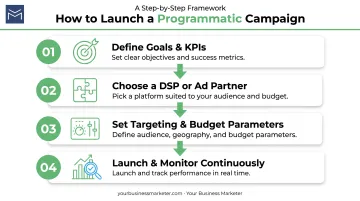
Getting started follows a fairly consistent path:
- Define clear goals and KPIs — awareness, leads, or direct sales — before choosing anything else
- Choose a DSP or ad partner that fits your budget and target channels
- Set targeting and budget parameters, including geography and audience segments
- Launch and monitor continuously — and watch for ad fraud and brand safety gaps that drain budget on low-quality inventory
That last step trips up a lot of businesses managing this in-house. Ad fraud and brand safety settings aren't glamorous, but skipping them is how budget disappears without results.
This is why many small and mid-sized businesses partner with a full-service agency rather than building this expertise from scratch. YBM's programmatic advertising service handles audience targeting, real-time bid automation, and ongoing optimization so owners can stay focused on operations.
For example, an insurance agency client generated 1.25 million programmatic impressions in 90 days as part of a combined programmatic and social strategy.
Conclusion
Strip away the jargon, and programmatic advertising is just an automated matching process. Advertiser demand meets publisher supply, powered by real-time data and auctions that resolve in a fraction of a second. Once you see it that way, terms like DSP and RTB stop being intimidating and start being useful.
That clarity also makes platform and partner choices simpler: you know what each piece does and where you need help. If you'd rather not run DSP selection, bidding, and optimization yourself, reach out to YBM for managed programmatic campaigns so you can stay focused on the business.
Frequently Asked Questions
What is an example of programmatic advertising?
A common example: a shopper views a pair of boots on a retailer's site, then sees a banner ad for that same product on a news site or app later that day. That ad was bought automatically through real-time bidding, not booked manually.
Are Google Ads and Amazon DSP programmatic advertising?
Amazon DSP is a true programmatic buying platform across display, video, audio, and streaming TV. Google Ads combines programmatic display and video buying with Search ads, which run on a separate, non-programmatic keyword auction.
What are the four main types of programmatic advertising?
The four deal types are open marketplace (RTB), private marketplace, preferred deals, and programmatic guaranteed. They differ mainly in exclusivity, pricing, and whether impression volume is guaranteed.
How much does programmatic advertising cost?
Cost is typically based on CPM (cost per thousand impressions) and varies by audience niche, competition, and ad format. There's generally no fixed minimum spend required to start a campaign.
Is programmatic advertising a good fit for small or local businesses?
Yes. Flexible budgets and granular geographic and demographic targeting make it accessible even for single-location businesses, especially when an experienced partner manages setup and bidding strategy.
What's the difference between programmatic advertising and PPC campaigns like Google Search Ads?
PPC search ads compete in keyword auctions for placements inside search results. Programmatic automates buying of display, video, and CTV inventory across many publishers based on audience data rather than keywords.