Whoever shows up in that moment gets the job. Everyone else doesn't exist to that homeowner.
Many roofing contractors still lean almost entirely on referrals, truck signage, and paid ads that vanish the moment the budget runs dry. That approach works until it doesn't — and it leaves lead flow feeling like a slot machine instead of a system. Roofing SEO fixes that by making your business the one Google shows when someone needs a roof fixed now.
This guide covers local SEO, keyword strategy, on-page optimization, content, technical fixes, link building, the mistakes that quietly tank rankings, and how to know when it's time to bring in outside help.
Key Takeaways
- Local SEO — Map Pack presence, reviews, and citations — drives the fastest, highest-volume roofing leads
- Dedicated city and service pages outperform one generic "services" page every time
- Keywords that pair service, location, and intent bring higher-quality roofing leads than volume alone
- SEO compounds over 60-90 days and beyond, unlike ads that stop the second you stop spending
- Thin content, generic branding, and missing trust signals sink rankings faster than any single fix can save them
What Is Roofing SEO and Why It Matters
Roofing SEO is the process of optimizing your website, Google Business Profile, and broader online presence to rank for searches like "roof replacement Cleveland" or "emergency roofer near me." It sounds like standard local SEO. It isn't quite the same animal.
Roofing searches carry a different weight. A homeowner Googling a roofer usually has a real, visible problem — a leak, storm damage, a bald patch of missing shingles — and money they're ready to spend soon. Compare that to someone browsing for a new pair of shoes. There's no browsing phase in a roof emergency.
Homeowners Are Already Searching Before They Call
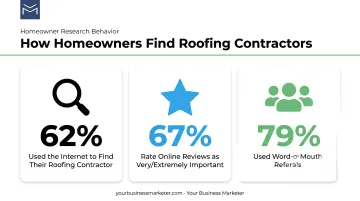
62% of homeowners used the internet to find their roofing contractor, according to the 2025 Homeowner Roofing Survey. That same survey found 67% rated online reviews as "very" or "extremely" important to their hiring decision.
Referrals still matter: 79% of homeowners used word-of-mouth in some form. But if your website isn't showing up when the other 62% search, you're invisible for the majority of your potential jobs.
Why SEO Beats a Paid-Ads-Only Approach
Paid ads generate leads exactly as long as you keep paying for clicks. Turn off the budget, and the phone stops ringing. SEO works differently. Once a page ranks, it keeps generating leads without a per-click cost attached.
That doesn't mean SEO is instant. Google itself has said SEO improvements typically need four months to a year to show potential benefit, though many roofers see initial movement sooner in less competitive markets.
The compounding effect is real. YBM's HIVE program is built specifically for home services and home improvement contractors, including roofing companies. One HVAC client saw an 85% revenue increase over two years through an integrated strategy combining SEO, reputation management, email marketing, and paid channels.
That's not an overnight win. It's what steady, layered digital marketing looks like when given time to work.
Local SEO and Google Business Profile Domination
For roofers, local SEO is the foundation everything else sits on. Most jobs come from a tight radius around your service area, and Google knows that.
Optimizing Your Google Business Profile (GBP)
Your Google Business Profile is often the first thing a homeowner sees, before they ever click through to your website. Getting it right matters as much as the website itself.
- Select accurate categories — "Roofing Contractor" as primary, with relevant secondary categories added
- Complete your service area — list every city and suburb you actually cover
- Post weekly — photos of completed jobs, storm damage repairs, crew shots keep your profile active
- Respond to every review — positive and negative, using natural language that mentions your services and location
That last point does double duty. Thoughtful responses build trust with readers and reinforce the local, service-specific keywords Google associates with your profile.
Citations, NAP Consistency, and Online Reviews
NAP stands for Name, Address, Phone, and it needs to match, word for word, across every directory, the Chamber of Commerce listing, and every roofing-industry directory you appear in. Inconsistency confuses Google's algorithm about which business is legitimate.
The stakes are higher than most contractors assume. According to BrightLocal's Local Business Discovery & Trust Report, 62% of consumers said they'd avoid a business after finding incorrect information online. Another 46% lose trust over a wrong address alone.
Reviews carry similar weight. Only 4% of consumers say they never read reviews before hiring, meaning 96% at least sometimes do. For roofers specifically, 67% of homeowners called reviews very or extremely important.
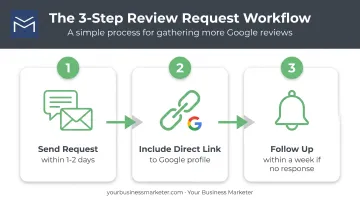
A simple, repeatable process works best:
- Send a review request via text or email within a day or two of job completion
- Include a direct link to your Google profile to reduce friction
- Follow up once if there's no response within a week
Why the Map Pack Is the Ultimate Local SEO Prize
The Map Pack (those three business listings that appear with a map above regular organic results) captures a huge share of local search clicks. BrightLocal's Local Services Ads click study found the Local Pack captured roughly 32% of clicks in service-area-business searches, even without paid Local Services Ads present.
Ranking there takes ongoing work: active GBP posts, consistent citations, and steady review growth. A profile you set up once and ignore will not hold its spot.
Keyword Research and On-Page SEO Essentials
Getting found starts with targeting the right words. Roofers who chase generic, high-volume keywords often waste budget competing against national brands for terms that don't convert.
Finding the Right Roofing Keywords
Roofing keywords fall into three buckets:
- Service terms — roof repair, roof replacement, new roof installation
- Location terms — "[city] roofer," "roofing contractor near me"
- Question/problem terms — storm damage signs, roof leak causes, shingle lifespan
Google autocomplete and the "People Also Ask" boxes reveal exactly what real homeowners type. Tools like Ahrefs or SEMrush go further, surfacing low-competition suburb keywords with genuine buying intent that bigger competitors overlook.
Matching the keyword to search intent matters just as much as finding it. According to Semrush's search intent research, searches split into informational (learning something), commercial (comparing options), and transactional (ready to act) intent.
A blog answering "how long do shingles last" and a service page targeting "roof replacement near me" need completely different content. Mixing them up wastes the ranking potential of both.
On-Page Optimization Best Practices
Once you know your keywords, on-page structure determines whether Google understands what each page is actually about.
- Title tags and H1s should include the target keyword naturally — "Roof Replacement in Akron, OH" beats a vague "Our Services"
- Meta descriptions should be unique per page, summarizing what that specific page offers
- URLs should be descriptive: /roof-replacement-akron, not /services?id=4
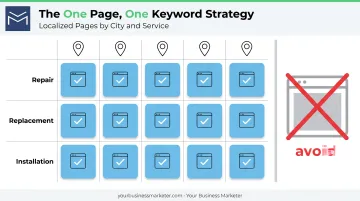
The single biggest mistake roofers make here is cramming everything onto one generic services page. The fix is the "one page, one keyword" rule: build separate pages for each service and each city you serve.
A roofer covering five cities and three services should have fifteen dedicated pages, not one page trying to rank for all of them. One page stretched across fifteen keywords dilutes relevance, so Google struggles to rank it for any of them.
Round out each page with image alt text describing the actual job pictured, plus internal links connecting related service and location pages.
Content, Technical SEO, and Link Building for Roofers
Rankings need more than a well-built homepage. Sustained authority comes from content, technical health, and the links pointing back to your site.
Blog Content That Builds Authority
Answering real homeowner questions (how to spot storm damage, what affects shingle lifespan, when a repair beats a full replacement) does two things at once. It targets long-tail keywords with less competition, and it builds trust with readers before they've even called.
Structure matters here too:
- Headings: clear H2/H3s that break up the text
- Photos: real job shots, not stock images
- Updates: refresh older posts so they stay current
Technical SEO Fundamentals
None of the above matters if your site is slow or broken on mobile. Google's Core Web Vitals standards define "good" performance as loading in under 2.5 seconds, responding to interaction within 200 milliseconds, and staying visually stable.
Priority checklist:
- Mobile responsiveness — most roofing searches happen on a phone, standing in front of storm damage
- HTTPS — a baseline trust and security signal
- XML sitemap — helps Google find and crawl every page
- No thin or duplicate pages — each page needs unique, substantial content
Once the site loads fast and reads cleanly on mobile, the next lever is who links to you.
Earning Quality Backlinks
A handful of relevant, high-quality backlinks beats hundreds of low-quality ones.
Local directories, Chamber of Commerce listings, sponsorships, and guest posts on industry sites all send a trust signal Google actually values. Ahrefs notes that link quality depends on the linking site's authority, topical relevance, and placement: not sheer volume.
Skip the shortcuts. Buying links violates Google's spam policies and risks tanking rankings you've spent months building.
Avoiding Common Mistakes and Choosing the Right SEO Partner
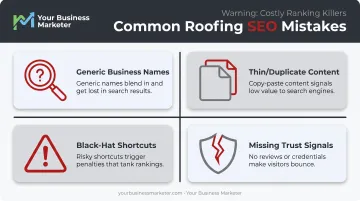
Common Roofing SEO Mistakes to Avoid
Some mistakes are avoidable with a little foresight:
- Generic or non-unique business names confuse local search algorithms trying to match your listing to searches
- Thin, duplicate content across city pages fails to rank because Google can't tell the pages apart
- Black-hat shortcuts like keyword stuffing, purchased backlinks, and fake reviews risk manual penalties that erase months of progress overnight
- Missing trust signals (no visible reviews, license number, real job photos, or clear CTA) bring traffic that never converts into booked jobs
Ranking is only half the job. A page that ranks but doesn't convert is a wasted opportunity.
When and How to Bring in Professional Help
Most roofers can grasp the fundamentals above. Fewer have the time to publish consistently, track rankings, and adjust strategy month after month while also running job sites.
When you're ready to hand it off, look for:
- Industry experience with home services or home improvement clients specifically
- Transparent reporting tied to calls, leads, and actual customers, not just traffic screenshots
- Proven case studies, not vague promises of "#1 rankings"
YBM's HIVE program was built for this exact need. It bundles SEO with Google Ads, email marketing, reputation management, social media, geofencing, and programmatic advertising into one coordinated system instead of six disconnected vendors.
The program tracks calls, qualified leads, and actual customers rather than stopping at traffic numbers. Daily optimization keeps campaigns responsive instead of set-and-forget.
Frequently Asked Questions
What is SEO and how does it work?
SEO (search engine optimization) is the process of improving a website's visibility in organic search results. It works by aligning your content, technical structure, and authority signals with what search engines and searchers are actually looking for.
How long does it take to see results from roofing SEO?
Initial movement often appears within 60-90 days. Significant, compounding results typically build over 3-6 months and beyond, especially in competitive metro areas.
How much does roofing SEO typically cost?
Costs vary by market competitiveness, service area size, and scope of work. Many roofing companies fund SEO as part of a broader marketing budget and shift spend toward the channels that actually produce paying jobs.
What's the difference between ranking in the Google Map Pack versus organic search results?
The Map Pack shows three local businesses based on Google Business Profile signals like relevance, distance, and prominence. Organic results rank website pages on content and authority. A complete local strategy needs both.
What are the best keywords for a roofing company to target?
A mix of service-plus-location keywords (like "roof replacement Akron") and long-tail question keywords (like "signs of hail damage on shingles") covers both ready-to-hire searchers and those still researching.
Do I need a roofing-specific SEO agency, or can any digital marketing company help?
Industry familiarity helps, but a proven full-service agency experienced with home services contractors (like YBM's HIVE program) can deliver strong results through an integrated, multi-channel strategy rather than SEO alone.