The result? Many owners never sit down to write an actual marketing plan. They post on social media when they remember, run an ad when sales dip, and hope something sticks.
The bigger problem isn't lack of effort. It's too many channels, conflicting advice, and no clear framework for deciding where a limited budget should go. This guide walks through building a real strategy, picking the right channels, budgeting with intention (including the 70/20/10 and 40/40/20 rules), and dodging the mistakes that drain small business budgets fastest.
Key Takeaways
- Marketing success starts with a defined audience and message, not with picking channels first
- Mastering 2-3 aligned channels beats a thin presence on ten
- Budget frameworks like 70/20/10 and 40/40/20 replace guesswork with planned allocation
- Tracking KPIs and adjusting based on data separates growing businesses from stalled ones
- Choose DIY, in-house, or an agency based on your time, budget, and expertise gaps
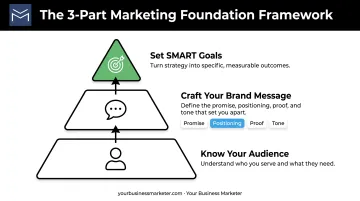
Step 1: Lay the Foundation — Know Your Audience, Message & Goals
Most marketing failures don't come from picking the wrong channel. They come from skipping strategy entirely and jumping straight into tactics. A business runs Facebook ads because a competitor does, without first answering who they're trying to reach or what they need to hear.
Define Your Ideal Customer Beyond Demographics
Age and location matter, but they don't explain why someone buys. Dig into:
- Behaviors: How do they research before purchasing? Do they compare prices or go with the first trusted recommendation?
- Pain points: What specific frustration pushed them to search for a solution today?
- Buying motivations: Price, convenience, trust, or urgency?
- Objections: What almost stopped them—price, trust, timing, or a competitor?
A simple buyer persona template takes about an hour to fill out: name, role, primary goal, biggest objection, and where they spend time online. For example, an HVAC company might target a homeowner with a 12-year-old system who searches on mobile after a breakdown—not "adults 35–65 in the metro area." Skip this step and messaging usually falls flat.
Build a Brand Message That Holds Up Everywhere
Your brand promise is the one thing customers can count on. Your positioning statement explains why you, specifically, over the next option they find. Write these down before you touch a channel:
- Promise: The outcome customers can reliably expect
- Positioning: Why you over the next option they find
- Proof: One result, credential, or differentiator that makes the claim believable
- Tone: The same voice on your website, ads, and every email
If the message only works in an ad and falls apart on your homepage, it is not ready.
Set SMART Goals Tied to Revenue
Specific, Measurable, Achievable, Relevant, Time-bound. "Get more leads" isn't a goal. "Generate 20 qualified leads per month by Q3" is.
Tie each goal to revenue or pipeline so you can judge channels later by contribution, not vanity metrics.
Before you leave this step, run a lightweight competitor scan. Check three competitors' websites, ads, and reviews. Look for gaps in messaging or service they are not addressing—that gap is often your opening.
Step 2: Choose the Right Marketing Channels for Your Business
Trying to run five channels at once is one of the fastest ways small business marketing underperforms. Master one to three channels tied to your audience and goals before adding more.
Local SEO & Google Business Profile
For local businesses, a complete Google Business Profile is the highest-leverage free marketing tool available. Google itself states that businesses with complete, accurate profile information are more likely to appear in local search results. Relevance, distance, and prominence drive local rankings.
Quick wins:
- Complete every profile field, including hours, services, and attributes
- Add fresh photos monthly
- Respond to every review, positive or negative
Social Media Marketing
Match the platform to your audience, not the other way around. Visual, younger audiences respond to Instagram and TikTok. B2B and professional audiences lean toward LinkedIn.
Posting benchmarks for small teams:
- Instagram and TikTok: 3-5 posts weekly
- Facebook: 1-2 posts daily
- LinkedIn: 3-5 posts weekly
Frequency matters less than consistency. Buffer's analysis of over 100,000 users found that accounts posting in at least 20 out of 26 weeks earned more than 5 times the median engagement per post compared to accounts posting sporadically. Pick fewer platforms and post on a schedule you can actually keep.
Email Marketing
Email is the one channel you fully own. No algorithm can bury your message in someone else's feed. Build your list through:
- Website opt-in forms
- In-person sign-up asks
- Links in your social bios
Litmus's 2025 State of Email research found that 35% of marketing leaders see $10-$36 in return for every $1 spent, with another 30% seeing $36-$50.
A basic automated welcome sequence (three to five emails introducing your business and answering common questions) nurtures new subscribers with almost no ongoing effort once it's built.
Pay-Per-Click & Paid Advertising
Paid ads deliver faster visibility; organic channels build long-term equity. Use paid ads when you:
- Need leads now
- Want to test a new offer
- Need hyper-local reach through geofencing around a service area or competitor location
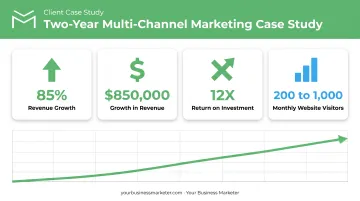
A Northeast Ohio HVAC contractor shows what a coordinated approach can deliver. The company combined SEO, PPC, email marketing, reputation management, and social media over two years.
Revenue grew 85%, translating to $850,000 in growth and a 12X return on investment. Monthly website visitors climbed from 200 to nearly 1,000 in a single month.
Content Marketing & SEO
Content marketing builds authority and feeds SEO by answering the questions prospects search before they buy. Start with 4-5 cornerstone blog posts on your most common pre-purchase questions, such as:
- How much does [service] cost in my area?
- How do I choose the right [provider type]?
- What separates quality work from a cheap fix?
These posts become long-term assets that keep attracting traffic long after you publish them.
Step 3: Budget Your Marketing the Right Way
There's no single revenue percentage that fits every small business. Marketing spend typically lands between 5% and 20% of gross revenue for businesses actively investing in growth.
The right number depends on how aggressively you're trying to grow and how competitive your market is.
The 70/20/10 Rule
According to HubSpot, this approach allocates 70% of your marketing budget to proven strategies, 20% to newer strategies showing promise, and 10% to experimental ideas. Treat it as a practical risk-management guide, not a rigid formula.
Example for a $4,000 monthly budget:
| Allocation | Amount | Use |
|---|---|---|
| 70% (Proven) | $2,800 | Google Business Profile, existing PPC campaigns |
| 20% (Emerging) | $800 | New social platform, expanded content |
| 10% (Experimental) | $400 | Geofencing test, new ad format |
The 40/40/20 Rule
This framework governs where planning effort goes within a single campaign, not how dollars split across channels:
- 40% toward audience research and targeting
- 40% toward message and creative quality
- 20% toward execution and channel selection
Use 70/20/10 for ongoing budget allocation across your channel mix. Use 40/40/20 when planning an individual campaign so you don't jump straight to execution before defining who you're targeting and what you're saying.
Start new tactics with a smaller test budget, then reallocate spend toward whatever the data proves is working. Trial-and-error without a framework wastes money; structured planning, in-house or with outside help, shortens the learning curve.
Step 4: Build, Execute & Track Your Marketing Plan
Every marketing plan needs six components. Skip any one and accountability slips:
- Goals — what success looks like in measurable terms
- Audience — who you're trying to reach
- Channels — where you'll show up
- Timeline — when each tactic launches and ends
- Budget — how much you'll spend per channel
- Named owner — who owns each task
Assign owners, set the calendar, and launch. Then track the numbers that show whether the plan is working.
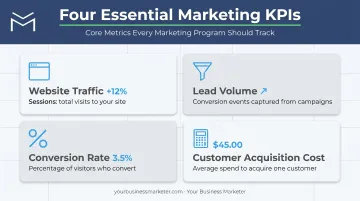
KPIs That Actually Matter
- Website traffic (sessions) — tracked free through Google Analytics
- Lead volume — completed conversion events, not just form views
- Conversion rate — conversions divided by total interactions
- Customer acquisition cost — total acquisition spend divided by new customers gained
Marketing results compound. A campaign that looks flat in month one often accelerates by month four as SEO gains momentum and retargeting audiences grow. Consistent testing beats chasing quick wins nearly every time.
Common Small Business Marketing Mistakes to Avoid
- Spreading budget too thin — trying to maintain five channels instead of mastering two or three
- Ignoring the data — reviews, analytics, and customer feedback all reveal what's working, but only if someone checks
- Abandoning strategies too early — quitting a channel after six weeks before it's had time to gain traction
DIY, In-House Hire, or Marketing Agency: Which Is Right for You?
The right choice comes down to three questions: How much time do you have? What's the budget? Where are the expertise gaps?
| Approach | Best Fit | Watch Out For |
|---|---|---|
| DIY | Very tight budget, one or two simple channels | Time drain; inconsistent execution |
| In-house hire | Steady budget, need for one core skill | One person rarely covers SEO, PPC, and social at once |
| Full-service agency | Multi-channel needs, limited internal bandwidth | Choose partners carefully (see criteria below) |
Full-service agencies make sense once you need SEO, PPC, social, email, and reputation management running together without hiring a full internal team.
Your Business Marketer, a Hudson, Ohio agency founded in 2016, focuses on that multi-channel gap. Founder Mike Snellenberger ran his own companies before starting YBM, so the model is built for owners who want execution handled without juggling five vendors.
YBM runs industry-specific programs such as HIVE for home services, CLEAR for auto dealerships, and FIT for nonprofits. Documented results include 85% HVAC revenue growth, a 40% traffic increase in 30 days, and a 36% year-over-year lead increase for an automotive client.
Vetting Criteria for Any Marketing Partner
Whatever partner you consider, hold them to a clear bar:
- Ask for case studies with specific numbers, not vague success stories
- Confirm reporting focuses on leads and revenue, not just impressions
- Avoid long-term contracts that lock you in without demonstrated results first
Frequently Asked Questions
What is the best marketing for a small business?
There's no universal answer. The best channel is wherever your target audience already spends time. A well-defined audience with consistent execution on 1-2 channels typically beats a scattered presence across many.
What is the 70/20/10 rule for marketing budget?
It splits budget into 70% for proven tactics, 20% for newer channels showing promise, and 10% for experimental ideas. This balances reliable performance with room to test what's next.
What is the 40-40-20 rule in marketing?
It weighs campaign planning effort: 40% audience research, 40% message and creative, 20% execution. Unlike 70/20/10, it's about where planning effort goes, not how dollars are split.
How much should a small business spend on marketing?
Most actively growing small businesses invest between 5% and 20% of gross revenue in marketing. The right figure varies by industry, competition, and growth stage.
Should I handle marketing myself or hire an agency?
It depends on your time, budget, and expertise gaps. Once you need more than one or two channels running well simultaneously, an agency typically becomes more practical than managing it solo.
How long does it take to see results from small business marketing?
Some channels move fast. Google Business Profile and email campaigns can show results within weeks. SEO and social media often take several months to build momentum.