The problem? A lot of local business owners run geofencing campaigns without understanding the mechanics behind them. A geofence that's too small misses potential customers. One that's too large wastes budget on people who will never walk through the door. Either mistake leads to poor engagement and wasted ad spend.
This guide breaks down what geofencing marketing actually is, how it works step-by-step, and where it tends to perform best.
TL;DR
- Geofencing uses virtual boundaries around real-world locations to target mobile users with location-relevant ads
- GPS, Wi-Fi, and Bluetooth detect when a device enters or exits a zone and trigger an ad
- Home services, auto dealerships, and local retailers use it to drive hyper-local foot traffic and leads
- Results hinge on fence size, audience segmentation, and privacy-compliant execution
What Is Geofencing Marketing?
Geofencing marketing is a location-based advertising strategy. It draws a virtual perimeter around a real-world location and delivers targeted ads to mobile devices that enter that space.
GroundTruth describes it as advertising that targets opted-in consumers in real time relative to a defined boundary: a specific, mapped-out zone, not a vague neighborhood.
That precision solves a real problem. Broad-radius targeting or demographic-only ad sets waste spend on people who aren't physically positioned to walk in and buy something. Geofencing narrows the audience to people who are actually near your storefront, dealership lot, or service area.
Geofencing vs. Geotargeting
These two terms get mixed up constantly, and the distinction matters:
- Geofencing creates a precise, GPS-defined boundary that triggers a real-time action the moment a device enters or exits it
- Geotargeting delivers content based on a broader area, such as a city, state, or ZIP code, without a real-time entry/exit trigger
Geofencing is a form of geotargeting, just far more surgical about it.
Why It Still Works as Cookies Fade
Third-party cookies are disappearing from browsers, but geofencing doesn't need them. It runs on first-party, opted-in location signals from a device's GPS or Wi-Fi connection, not tracking cookies. That independence is why the tactic has held up while other targeting methods have weakened.
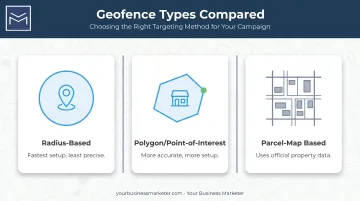
Three Main Geofence Types
- Radius-based — a simple circle drawn around an address; fastest to set up, least precise
- Polygon or point-of-interest — a boundary traced around the actual footprint of a store or venue; more accurate, more setup work
- Parcel-map based — uses official property boundary data; common in real estate targeting
How Does Geofencing Marketing Work?
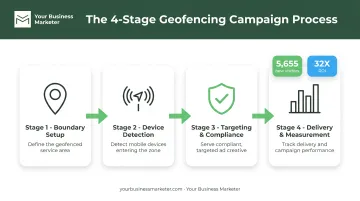
Every geofencing campaign follows the same basic sequence: boundary setup, device detection, ad delivery, then measurement. Here's how each stage plays out in practice.
Setting Up the Geofence
A business (or its marketing partner) defines the target area, either by drawing a radius or a custom polygon around a store, a competitor's location, or an event venue. YBM typically sizes these anywhere from a 2-mile radius for local foot traffic up to 200-plus miles for travel-driven markets, depending entirely on the client's goal.
Size should match how customers actually get there:
- Walkable businesses (coffee shops, retail in a downtown core) need a tighter fence, sometimes just a few blocks
- Drive-to businesses (dealerships, home improvement stores, suburban restaurants) need a wider radius that reflects realistic drive time
Before launch, the campaign needs accurate mapping data and a clear objective: foot traffic, brand awareness, or conquesting a competitor's customers. Skip that step, and everything downstream suffers.
Detecting Devices & Triggering Ads
Once the fence is live, detection happens through a mix of signals. GPS and Wi-Fi are the primary drivers. GroundTruth's geofencing guide confirms both are used to identify when an opted-in device enters the perimeter.
Bluetooth adds proximity detection for beacon-based setups. RFID shows up mainly in venue or retail environments.
When a device crosses the boundary, the ad platform automatically fires off the next action:
- A push notification
- A display ad
- An SMS message
- An in-app message
The speed and accuracy of that detection matters. A slow trigger means the message arrives after the customer has already left, which kills relevance instantly.
Refining Targeting & Ensuring Compliance
Location alone isn't enough. Layer in audience segmentation: demographics like age, income, or household type, plus behavioral data such as competitor visits or event attendance, to avoid serving ads to people who happen to be nearby but aren't a real fit.
Frequency capping and consent protocols matter just as much:
- Cap impressions per user to avoid notification fatigue
- Confirm the app or platform obtained purpose-specific location consent, not a vague permission request
This isn't optional housekeeping. In 2024, the FTC ordered InMarket to stop selling precise consumer location data after alleging the company failed to disclose that location permissions collected for shopping or rewards features were also being used for targeted advertising.
Skip proper consent and disclosure, and you risk annoying users and drawing regulatory action.
Delivering Results & Measuring Performance
A well-run geofencing campaign shows up as increased foot traffic, click-throughs, and conversions tied directly to the geofenced audience. That data then feeds attribution models, connecting a specific ad exposure to an actual store visit or lead.
A 2025 GroundTruth restaurant campaign reported more than 5,200 visits at an average $3.21 cost per visit across three markets.
YBM's own Hudson city-wide geofencing campaign generated 3.55 million impressions, drove 5,655 new merchant visitors, and returned an estimated 32X return per visitor for participating local merchants. Results like these are campaign-specific, not universal guarantees, but they show what's achievable when the setup is done right.
Where Is Geofencing Marketing Used?
Geofencing performs best when a business has a clear, physical intent location tied to a measurable outcome. That's why certain industries lean on it more than others:
- Retail — reaching shoppers near stores and measuring in-store actions
- Restaurants/QSR — capturing lunch and dinner intent from nearby foot traffic
- Auto dealerships — targeting shoppers at their own lot or a competitor's
- Real estate — fencing open houses and competing listings
- Home services — reaching people near hardware stores or project-related retailers
- Live events — capturing a concentrated, time-bound audience at a venue
A Real-World Example: Conquesting a Competitor's Lot
Picture a used car dealership that wants to pull shoppers away from a competitor a few miles down the road. The dealership (or its marketing partner) draws a polygon geofence directly around the competitor's lot. When a shopper's phone crosses into that boundary, an ad fires with a trade-in offer or a lower-price alternative on a similar model.
YBM runs this as a standard dealership tactic: placing digital markers around competing lots, then layering in demographic data to sharpen who sees the offer. It's a direct, timely nudge at the exact moment someone is already comparison shopping.
That same timing logic applies beyond auto retail. Geofencing works best when at least one of these conditions is true:
- High foot-traffic density around the fenced location
- Event-driven windows with a clear start and end
- A drive-time radius in areas where walking traffic isn't realistic
Benefits of Geofencing Marketing
Cost Efficiency
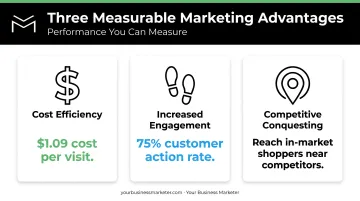
Narrowing the target area to people physically near a relevant location cuts down on wasted impressions. Instead of paying to show ads across an entire metro area, budget goes toward the people most likely to convert. A Simpli.fi fast-food campaign, for example, reported $1.09 cost per visit against a $5 target, driving over 215,000 visits.
Increased Engagement and Foot Traffic
Timing matters. A hyper-relevant, well-timed ad tends to outperform a generic one. Internal YBM data points to a 75% customer action rate after receiving a location-based message, with more than half going on to visit a retailer.
Competitive Conquesting
Targeting visitors at a competitor's location (a dealership lot, a competing contractor's job site, a nearby retailer) with a compelling offer is one of geofencing's sharpest advantages. It reaches people already in a buying mindset, just not yet committed to a brand.
Getting all three benefits right takes more than drawing a circle on a map. You need correct fence sizing, segments based on real buying behavior, and campaigns tied into SEO and PPC so the channels compound rather than fight for the same budget.
YBM builds that approach into programmatic and geofencing programs for home services, auto dealerships, and local businesses.
Conclusion
Geofencing marketing works by pairing location-detection technology with precisely timed, relevant ad delivery. It reaches people exactly when and where they're most likely to act. That combination is what separates it from broader digital ad tactics that cast a wider, less intentional net.
Before launching a campaign, weigh your audience density, your campaign goals, and privacy compliance requirements. Getting the geofence size wrong, or skipping consent protocols, undermines the whole effort. A full-service digital marketing partner can simplify setup and keep the campaign optimized as results come in.
Frequently Asked Questions
What is geofencing in marketing?
Geofencing in marketing is a location-based advertising method that uses a virtual boundary around a specific area. When a mobile device enters or exits that boundary, it triggers a targeted ad or message.
How do you do geofencing marketing?
Define your geofence boundary, connect it to a geofencing or programmatic ad platform, set your audience targeting rules, then launch. Ads trigger automatically when a device crosses the defined line.
Can you give me an example of geofencing marketing?
An HVAC contractor sets a geofence around a neighborhood and serves a same-day tune-up offer to mobile users who enter that zone. The ad reaches nearby homeowners when they’re most likely to need service.
How much does geofencing marketing cost?
Cost varies by platform, geofence size, and campaign length, typically priced on a cost-per-thousand-impressions (CPM) or flat monthly basis. Since pricing depends heavily on your specific goals, it's worth reaching out to a provider for a custom quote.
What's the difference between geofencing and geotargeting?
Geofencing uses a precise, real-time boundary that triggers an action the moment a device enters or exits it. Geotargeting delivers content based on a broader area, like a city or ZIP code, without that real-time trigger.
Is geofencing marketing effective for small, local businesses?
Yes — often more so than for large national brands. Small businesses have limited budgets, and geofencing focuses that spend on nearby, high-intent customers instead of a broad, less relevant audience.