Yet many business owners pay for SEO without knowing what it actually does behind the scenes. That gap leads to unrealistic timelines, wasted budget, and frustration when rankings don't move overnight.
This guide breaks down what SEO is, how it works step-by-step, and where it fits into a real marketing strategy — not just the textbook definition.
TL;DR
- SEO optimizes a website so it ranks higher in unpaid organic search results
- Search engines process pages in three stages: crawling, indexing, and ranking
- On-page, off-page, and technical SEO form the three core pillars
- Unlike paid ads, SEO builds compounding visibility that keeps working after spend stops
- Local service businesses, ecommerce stores, and nonprofits each need a different SEO playbook
What Is SEO?
SEO, or search engine optimization, is the process of improving a website's content, structure, and authority so it ranks higher in organic (unpaid) search results. Google defines it as "helping search engines understand your content, and helping users find your site and make a decision about whether they should visit your site through a search engine."
Search engines exist to connect a user's query with the most relevant, trustworthy answer. SEO is how a website qualifies for that match. There are no shortcuts and no guaranteed first-place ranking.
SEO vs. SEM: Not the Same Thing
SEO often gets lumped in with search engine marketing (SEM), but they work differently:
- Channel: SEO earns unpaid organic listings; SEM/PPC buys ad placements
- Speed: SEO builds visibility gradually; paid ads can show up immediately
- Lifespan: SEO compounds over time; paid visibility stops when spend stops
Does SEO Still Matter With AI Search?
Yes. Google states plainly that standard SEO best practices remain relevant to AI Overviews and AI Mode. To be cited in an AI-generated answer, a page still must be indexed and eligible for a regular snippet. AI didn't replace SEO fundamentals; it added another surface where those fundamentals matter.
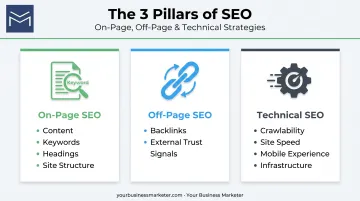
The Three Types of SEO
Each type targets a different part of the ranking process:
- On-page SEO — content, keywords, headings, and site structure
- Off-page SEO — backlinks and external trust signals
- Technical SEO — crawlability, site speed, mobile experience, and infrastructure
How Does SEO Work?
SEO functions through a defined sequence: crawling, indexing, ranking, and delivering results. Each stage feeds into the next, and a breakdown at any point stalls everything downstream.
Crawling & Discovery
Search engines use automated bots (often called "crawlers" or "spiders") that continuously scan the web, following links from page to page to find new or updated content. This process runs constantly and automatically, but site owners aren't powerless. Sitemaps and clean internal linking help guide crawlers to important pages faster.
Common bottlenecks that block crawling:
- Broken internal links that dead-end a crawler's path
- Poor site architecture that buries key pages too deep
- Misconfigured robots.txt files that accidentally block search engines
Indexing & Content Analysis
After crawling, search engines analyze pages and store them in a massive database called the index. This is where they evaluate what a page is about: keywords, headings, metadata, and structured data all come into play.
Pages with clear structure and original content tend to get indexed faster and more accurately. Thin or duplicate content often gets ignored or indexed poorly, which is why content quality matters before rankings even enter the picture.
Ranking & Algorithm Signals
After indexing, search engines apply hundreds of ranking factors to decide result order: relevance, content quality, backlink authority, and user-experience signals like Core Web Vitals. E-E-A-T (Experience, Expertise, Authoritativeness, Trustworthiness) and backlinks act as a quality-control layer, filtering out manipulative or low-value content.
This layer isn't static. Google confirms it makes broad, significant core updates several times a year, plus smaller unannounced tweaks on a rolling basis. That's exactly why "set it and forget it" SEO doesn't work. A strategy that ranked well last year can slip without ongoing adjustment.
Search Results & Business Outcomes
Qualifying pages appear in search engine results pages (SERPs): standard blue links, featured snippets, or AI Overviews. From there, organic visits feed the marketing funnel: becoming leads, calls, form fills, or purchases.
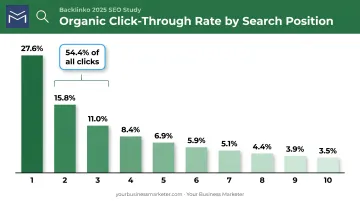
Position matters enormously. Backlinko's 2025 study of over 1.3 million pages found:
- 27.6% average click-through rate for the #1 organic position
- Position 1 gets 10 times more clicks than position 10
- The top three results capture 54.4% of all clicks
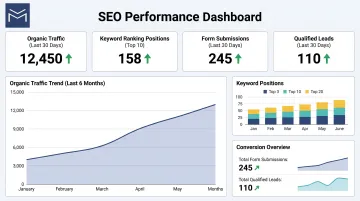
YBM tracks this full pipeline for clients rather than stopping at rankings. One internal dashboard example showed 153 form submissions producing 5 qualified leads at a 3.3% conversion rate, the kind of downstream metric that actually matters to a business owner, not just a keyword position.
Where SEO Is Used
SEO applies across nearly every business model, but tactics shift depending on context. It performs best in:
- Competitive local markets where multiple businesses fight for the same customers
- Industries with longer sales cycles, where buyers research extensively before purchasing
- Markets where customers search before buying, not only impulse or referral
Local SEO: A Different Game for Small Businesses
Local SEO diverges from broader national strategy. It leans on Google Business Profile optimization, local citations, and location-based keyword targeting.
YBM's work with a Northeast Ohio HVAC contractor shows the payoff. The campaign reached #1 rankings in Northeast Ohio for terms like AC Installation and AC Service and Repair. A permanent makeup salon client hit #1 rankings within 90 days for microblading-related searches.
Industry-Specific Tactics Beat Generic Playbooks
A plumbing company, a car dealership, and a nonprofit aren't competing for the same search intent, so a one-size-fits-all approach rarely works. Your Business Marketer (YBM) builds industry-specific SEO programs around that reality:
- HIVE (home services): keyword research, content, plus technical work like Core Web Vitals and mobile-friendliness audits
- CLEAR (automotive): ties SEO to dealership outcomes; one Chevrolet dealer reached 29 keywords in first place with a 4.63/5 local reputation score
- FIT (nonprofits): tracks donor engagement and site growth, not just impressions
That dealership focus matters: roughly 70% of car buyers begin on Google, and about 65% of clicks go to the top five results.
SEO Rarely Works Alone
SEO works best when coordinated with paid search, paid social, and reputation management rather than run alone. One HVAC client combining SEO with PPC, reputation management, social, and email grew from 200 to nearly 1,000 monthly visitors in a single month (about 400%). Those gains came from channels reinforcing each other.
Why SEO Matters in Digital Marketing
Organic search remains one of the largest sources of website traffic compared to paid or social channels, and it behaves differently from paid advertising.
SEO vs. SEM, side by side:
| Factor | SEO | SEM/PPC |
|---|---|---|
| Traffic when spending stops | Continues | Stops immediately |
| Time to results | Months | Immediate |
| Cost structure | Time, tools, expertise | Ongoing ad spend |
| Visibility type | Compounding | Rental |
Ahrefs' 2025 analysis of 1.3 million US keywords found that 72.9% of top-10 ranking pages were more than three years old, with the average #1 page sitting at five years old. That's strong evidence that organic visibility builds over time rather than appearing overnight.
Paid ads work differently by design. Google Ads Help confirms that a paused campaign simply stops running. There's no residual visibility once the budget dries up.
That contrast is why measurement matters. Tracking organic traffic, keyword rankings, and conversions lets a business justify and refine its SEO investment instead of guessing whether it's working.
Conclusion
SEO is an interconnected system: crawling feeds indexing, indexing feeds ranking, and ranking feeds business outcomes, with continuous optimization tying it all together.
Understanding that system changes how a business evaluates results. It's the difference between panicking after month one and knowing that meaningful movement typically takes three to six months, sometimes longer in competitive industries.
Whether a business manages SEO in-house or partners with a full-service agency like Your Business Marketer, that foundational understanding keeps expectations realistic and budget from being wasted on the wrong timeline.
Frequently Asked Questions
Is SEO still worth it in 2026?
Yes. Google's own documentation confirms standard SEO practices still apply to AI Overviews and AI Mode, which pull from indexed, eligible pages. Strong, well-optimized content supports both classic rankings and AI-generated answers.
How long does it take to see results from SEO?
Most businesses see measurable results in 3–6 months, per Search Engine Land's 2026 benchmark; competitive industries often need 6–12 months. Google recommends waiting at least a few weeks before judging whether changes worked.
What is the difference between SEO and SEM?
SEO focuses on unpaid, organic rankings built through content and technical optimization. SEM includes paid search advertising, which delivers instant visibility but stops the moment spending pauses.
Can a small business do SEO on its own, or does it need an agency?
Basic SEO — like claiming a Google Business Profile or fixing obvious site issues — can be self-managed. Competitive industries, however, often benefit from professional expertise to avoid costly mistakes and save time.
Is SEO free, or does it cost money?
SEO doesn't require ad spend like PPC does, but it isn't free. It still takes time, tools, and often professional help for keyword research, content, and technical fixes.
What are the three main types of SEO?
On-page SEO covers content and keywords, off-page SEO covers backlinks and external trust signals, and technical SEO covers crawlability, site speed, and mobile experience. All three work together to influence rankings.